The Burden of Democracy by Pratap Bhanu Mehta
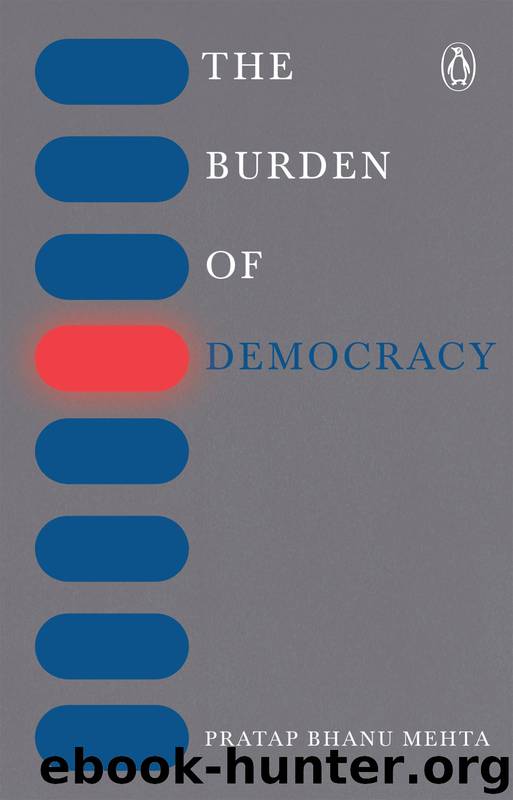
Author:Pratap Bhanu Mehta
Language: eng
Format: epub
ISBN: 9789387326446
Publisher: Penguin Random House India Private Limited
Published: 2017-11-03T04:00:00+00:00
State and Democracy
If the absence of any sense of reciprocity and mutual acknowledgement between citizens leaves a profound imprint on the character of Indian politics by generating an elusive politics of self-esteem, the workings of the Indian state reveal much about the limits, possibilities and meaning of democracy. The spectral scenes of human misery that still persist in crushing abundance are, in some ways, an indictment of democracy. Despite the improvements of the last decade or so, even a basic recitation of India’s human development indices, a casual perusal of their landscape, will bring home the violence built into India’s political economy with unnerving force. But the sad truth remains that we mostly pay attention to these facts, if at all, mainly because they are an embarrassment to us, not because we experience them as profoundly unjust. The fact that we are more embarrassed than outraged by these is a sign of the distances that separate us as citizens.
A full assessment of persisting misery despite democracy would require a complex analysis and weighing of different causes: bad policies, the absence of collective action, the weakness of any coherent ideology of reform amongst India’s powerful elites, the vice-like grip that vested interests have upon change and so forth. But surely the one agency that will be deeply implicated on this account is the Indian state.
In some ways, all modern societies are creations of the states that house them. The state, for good or for ill, emerged as a decisive form of political organization in the modern world, eclipsing its rivals such as empires, federations, city states, republics. While political thinkers in the Indian tradition have often seen the state as some kind of evil intellectual mistake, because of the enormous violence associated with its formation, the state has proved unprecedented in its capacity to organize collective power, reconstitute social relations, and act as a locus of identity. State formation and consolidation has everywhere extracted horrendous human costs. Despite this, in the modern world it seems that only not having a state is worse than having one. Even in an era when the talk of transcending the nation state is fashionable, it is clear that any organization or supranational entity that seeks to replace it will have to acquire many of the characteristics of a state to be successful.
India inherited a colonial state and kept much of its functioning architecture intact. Much of state practice, despite its massive quantitative expansion, is still heavily governed by legislation passed sometime between 1860 and 1947. In the aftermath of Partition, and in a politics greatly infused with a sense of both territorial insecurity and the lurking fear of internal disorder, the state quickly came to occupy a commanding presence in the Indian political imagination. At the time of Independence, there really existed no institutions that could even remotely rival the state in political legitimacy. The market, in the modern sense of the term, barely existed as a social force. Whatever potential it contained was considered
Download
This site does not store any files on its server. We only index and link to content provided by other sites. Please contact the content providers to delete copyright contents if any and email us, we'll remove relevant links or contents immediately.
| Anthropology | Archaeology |
| Philosophy | Politics & Government |
| Social Sciences | Sociology |
| Women's Studies |
The Secret History by Donna Tartt(19471)
The Social Justice Warrior Handbook by Lisa De Pasquale(12294)
Thirteen Reasons Why by Jay Asher(9122)
This Is How You Lose Her by Junot Diaz(7057)
Weapons of Math Destruction by Cathy O'Neil(6469)
Zero to One by Peter Thiel(5952)
Beartown by Fredrik Backman(5941)
The Myth of the Strong Leader by Archie Brown(5626)
The Fire Next Time by James Baldwin(5589)
How Democracies Die by Steven Levitsky & Daniel Ziblatt(5329)
Promise Me, Dad by Joe Biden(5230)
Stone's Rules by Roger Stone(5191)
A Higher Loyalty: Truth, Lies, and Leadership by James Comey(5090)
100 Deadly Skills by Clint Emerson(5023)
Rise and Kill First by Ronen Bergman(4906)
Secrecy World by Jake Bernstein(4889)
The David Icke Guide to the Global Conspiracy (and how to end it) by David Icke(4853)
The Doomsday Machine by Daniel Ellsberg(4624)
The Farm by Tom Rob Smith(4611)
